About
About PDAT and Inspector Play
Inspector Play is the home of the Physical Development Audit Tool (PDAT), developed by Dr Natalie Weir and Helen Battelley MA to help early years settings understand and strengthen physical development practice.
Why physical development
A Prime Area that deserves a closer look
Physical development is an EYFS Prime Area, yet it can be less visible within quality-improvement conversations than other areas of early learning.
PDAT gives you a structured way to look at what physical development actually looks like in everyday practice, indoors and out, across your whole setting.

Who’s behind PDAT
Developed by Dr Natalie Weir and Helen Battelley MA
PDAT brings Natalie’s research and evaluation background together with Helen’s practical expertise in early years physical development.
-
Dr Natalie Weir
Founder, Inspector Play
- PhD in early childhood physical activity and physical literacy
- University of Derby Game Changer Awards 2026: Global Impact Idea winner
- Inaugural Derby Impact Awards 2025: Social Entrepreneur of the Year finalist
Natalie has nearly 20 years’ experience across community sport development, programme and product development, senior leadership, and research and insight. She studied for her PhD at the University of Derby.
She founded Inspector Play to help others in their mission to reduce childhood inactivity, and passionately believes in the power of play, physical activity and PE to improve lives.
-
Helen Battelley MA
Early years physical development consultant, trainer and author
- Nursery World Early Years Trainer of the Year 2026
An internationally renowned physical development expert, Helen chairs the National Early Years Active Start Partnership (NEYASP). She is the author of Music and Movement: The Early Years (2018) and a second book with Bloomsbury (2020).
Helen lectures and trains for four universities on Initial Teacher Training modules, including Early Childhood Physical Development, and her consultancy takes her all over the world, from Malaysia to Dubai and from China to Romania.
As featured in Nursery World “Moving matters”: Natalie on what University of Derby research into young children’s physical activity means for practice (opens in a new tab)
The framework behind PDAT
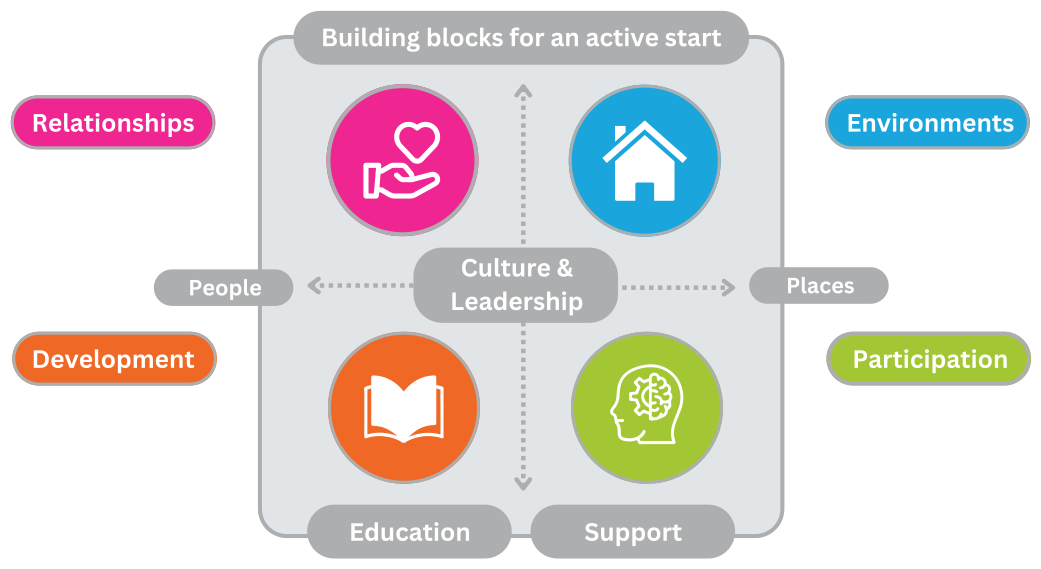
Building Blocks for an Active Start
The Building Blocks for an Active Start framework sets out key principles for supporting movement and physical development in early childhood. Each is connected to the Physical, Social, Cognitive and Affective domains of physical literacy, helping to nurture physical literacy holistically from birth to school age.
The framework brings these principles to life through practical, developmentally appropriate examples for infants (0–1), toddlers (1–3) and pre-schoolers (3–5).
Every PDAT statement links to a Building Blocks principle, so your results and recommendations always connect back to it.
© Weir & Battelley, 2025 · Building Blocks for an Active Start
Our approach to evidence
Honest about what we know so far
Initial pilot feedback suggests PDAT can support professional reflection and help settings identify practical next steps.
We are building the evidence base through repeat audits and larger evaluations, and we will only share what the evidence shows.
Ready to look at physical development across your setting?
Request access for your setting, or talk to us about licences for a nursery group or local authority.