PDAT: Physical Development Audit Tool for Early Years
Understand your practice. Recognise your strengths. Know what to do next.
A whole-setting audit to support physical development, physical activity and physical literacy.


Developed by Dr Natalie Weir and Helen Battelley MA
Who’s behind PDAT
See inside PDAT
-
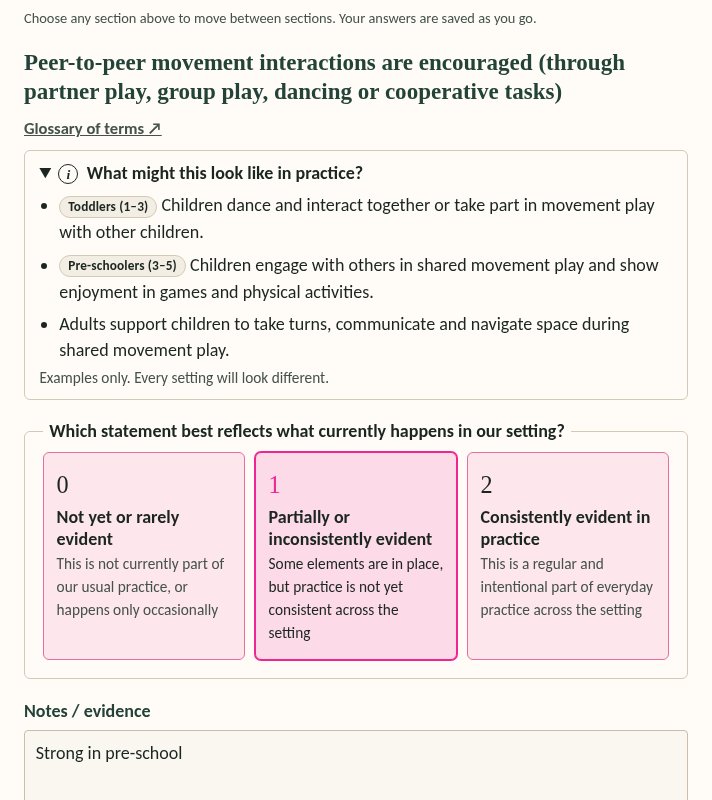
Answer each statement: choose 0, 1 or 2 and add a short note. -
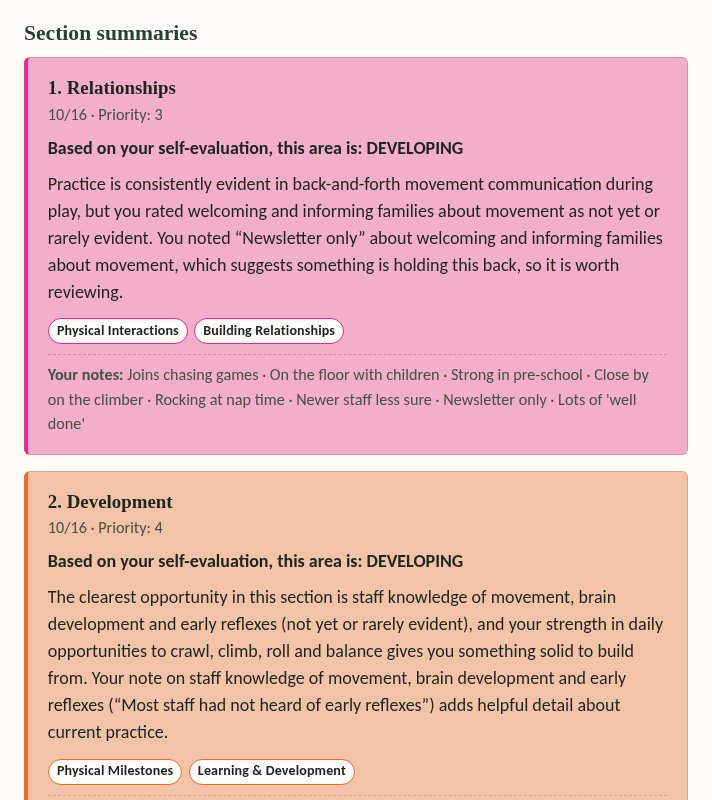
Section summaries: written from your own answers and notes. -
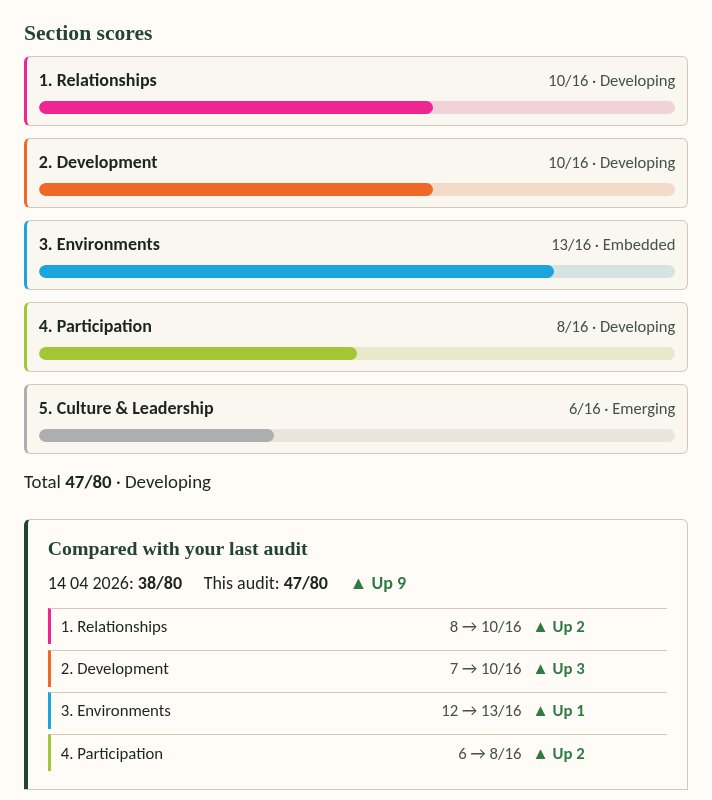
Your setting at a glance: scores and bands for all five sections. -
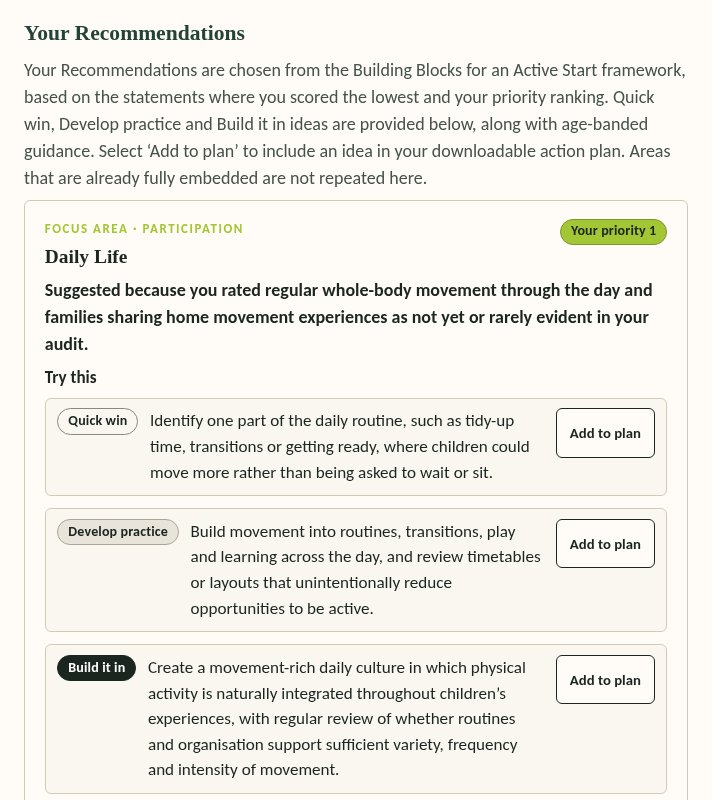
Recommendations: ideas matched to your priorities. -
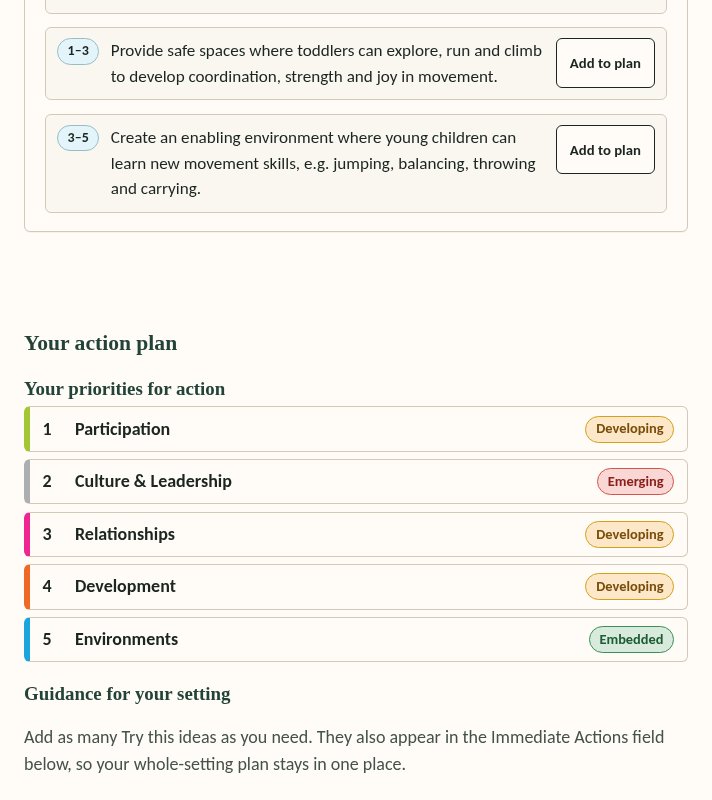
Action plan: add the ideas you choose and download your plan.


Expert-developed. Created by early years experts in research and practice.
Evidence-informed. Underpinned by the Building Blocks for an Active Start Framework © Weir & Battelley (2025).
Personalised to your setting. Your results and summary come from your own answers.
No AI-generated advice. Every recommendation comes from our expert action library.
How it works
From reflection to action in three steps
PDAT is a reflective self-evaluation tool, so there are no right or wrong answers.
-
1
Answer 40 statements
Rate eight statements in each of five sections for what usually happens in your setting. It takes around 30 to 60 minutes, and works well as a whole team.
-
2
See where you stand
Each section shows as Emerging, Developing or Embedded, with a summary that picks up your strengths and the areas worth a closer look.
EmergingDeveloping -
3
Get a tailored action plan
Choose your priorities and get practical recommendations for each one, ready to download and share with colleagues.
Who’s behind PDAT
Developed by Dr Natalie Weir and Helen Battelley MA
PDAT brings Natalie’s research and evaluation background together with Helen’s research knowledge in early childhood education and care and her practical expertise in early years physical development.
-
Dr Natalie Weir
Founder, Inspector Play
- PhD in early childhood physical activity and physical literacy
- University of Derby Game Changer Awards 2026: Global Impact Idea winner
- Inaugural Derby Impact Awards 2025: Social Entrepreneur of the Year finalist
A researcher with over 20 years’ experience across community sport development, programme and product development, senior leadership, and research and insight. Natalie founded Inspector Play to help others in their mission to reduce childhood inactivity.
-
Helen Battelley MA
Early years physical development consultant, trainer and author
- Nursery World Early Years Trainer of the Year 2026
- Association for Physical Education (AfPE) approved provider
- Chair of National Early Years Active Start Partnership (NEYASP)
An internationally renowned physical development expert, Helen delivers training on all aspects of physical development, from writing to physical play. She lectures and trains for four universities, including on Early Childhood Physical Development, and her consultancy takes her all over the world, from Malaysia to Dubai and from China to Romania.
As featured in
- Nursery World “Moving matters”: Natalie on what University of Derby research into young children’s physical activity means for practice (opens in a new tab)
- Early Years Educator Helen on risky play: building physical development and emotional resilience (opens in a new tab)
- Twinkl Education Insights Natalie on why focusing on gross motor skills early on will pay dividends in later life (opens in a new tab)
- Patchwork Programme podcast With HENRY: Let’s PLEY, Building Blocks for an Active Start and Project Springboard (opens in a new tab)
More
- Nursery World Helen on how learning-rich movement environments benefit all children (opens in a new tab)
- Nursery World Physical development: strategies to deliver the best range of experiences for young children (opens in a new tab)
- Nursery World Early years in schools: free range learning (opens in a new tab)
- Twinkl Education Insights Natalie on why we should reframe our thinking about physical activity (opens in a new tab)
- Twinkl Education Insights Natalie on physical literacy: what it means and why it’s so important (opens in a new tab)
- Early Movers Co-authors of the Movement Matters advisory resource (opens in a new tab)
Publications
- Frontiers in Sports and Active Living Weir, Tyler, Pringle and Roscoe (2026). Advancing physical literacy measurement in early childhood (opens in a new tab)
- Children Weir, Pringle and Roscoe (2024). Physical literacy and physical activity in early years education: what’s known, what’s done and what’s needed? (opens in a new tab)
- Children Roscoe, Taylor, Weir, Flynn and Pringle (2024). Impact and implementation of an early years fundamental motor skills intervention for children 4 to 5 years (opens in a new tab)
- N8 Research Partnership Weir and Roscoe (2024). Physical activity and maintaining a healthy weight, in An evidence-based approach to supporting children in the preschool years (opens in a new tab)
- Routledge Weir (2025). Moving beyond metrics: a holistic approach to physical development, in Early Years Essentials (opens in a new tab)
- Routledge Weir (2026). Beyond the grade: physical activity and physical literacy in early years education, in the Routledge Handbook of Physical Literacy (opens in a new tab)
Podcasts and blogs
- Aspire Active Education The Primary PE Huddle podcast (2024): Know more, show more, move more! (opens in a new tab)
- Athletic Skills Podcast Episode 11 (2024): Fun and physical literacy in early years physical development (opens in a new tab)
- So you want your kids to be great at sport The Sports Parenting Playbook, episode 7 (2025): Physical literacy, play and embracing chaos (opens in a new tab)
What PDAT looks at
Five sections, one whole-setting picture
Physical development is an EYFS Prime Area. PDAT examines indoor and outdoor, everyday practice and provision.
- Section 1
Relationships
Physical Interactions & Building Relationships
Physical interactions, co-play, attunement, relational safety, confidence and co-regulation
- Section 2
Development
Physical Milestones, Learning and Development
Physical milestones, motor competence, early learning links
- Section 3
Environments
Space to Move, Play and Outdoor Play
Space to move, outdoor play, enabling environments
- Section 4
Participation
Daily Life, Autonomy and Choice
Independence, motivation, child-led play
- Section 5
Culture & Leadership
Whole-Setting Culture
Shared vision, leadership, staff confidence, inclusion and whole-setting integration

Why movement matters
The challenges that drive our work
Dr Natalie Weir founded Inspector Play to help others in their mission to reduce childhood inactivity.
-

Rising obesity levels
-

Fewer young people enjoying physical activity
-

Increased use of technology over outdoor play
-

Existing inequalities have widened
What you get
More than a score
When you finish the audit, PDAT gives you practical guidance and support to help you take the next steps.
Watch a 1-minute tour
-
Results dashboard
Scores for every section, an Emerging, Developing or Embedded result and a personalised written summary built from your responses and notes, using our predefined, expert-developed framework.
-
Results and action plan PDFs
Download a clear results report and your action plan to share with colleagues and leaders.
-
Practical recommendations
Ideas for each of your priorities, drawn from Building Blocks for an Active Start, at three levels.
Quick winDevelop practiceBuild it in -
Progress over time
Repeat the audit and see what has changed since your last one. Every previous audit and action plan stays available.
-
Organisation reporting
For nursery groups and local authorities: every setting’s progress and results across your organisation in one place.
-
Help as you go
A glossary of terms and examples of what practice might look like, so every statement is clear.
What pilot settings said
Initial pilot feedback suggests PDAT can support professional reflection and help settings identify practical next steps.
Allpilot settings agreed that PDAT helped them identify and prioritise realistic next steps
Allpilot settings agreed that completing the audit prompted useful reflection or discussion among staff
“It was lovely to complete as a whole staff audit and made us all think about different elements that we could improve upon and also what we did well.”
Charlotte, Repton Manor Nursery “We would not have thought about considering some of the statements without the Audit Tool to prompt us.”
Lorraine, Rainbow Pre-School “It made us reflect on our attitude to movement within our indoor setting and how this differs to our forest setting.”
Claire, Wildlings
What changed
“Movement as part of co-regulation, we spent a long time discussing how we could use movement and how it could help them access a wide range of learning rather than a reactionary approach.”
Claire, Wildlings “Making us aware of areas we can celebrate and also areas to improve, we are actioning discussions with parents, starting points, cultural awareness and inclusion as well as sharing strategies with parents.”
Marion, Soar Childcare & Education “Sharing information with families about the importance of different movements.”
Jo, Carlton Colville Preschool
All of the pilot settings reported changes planned or already under way, including more heavy-work opportunities, lifting, wheeling and den-building resources, and new ways to share movement ideas with families.
Source: PDAT pilot user evaluation, first completed responses (September 2026). Pilot settings used the paper version of PDAT. This is early, formative feedback from a small sample.
Pricing
A 12-month licence for childminders, settings and groups
Every licence gives you the full Physical Development Audit Tool (PDAT): the audit, your results and tailored recommendations.
Charitable organisation? Contact us about a discount.
-
Childminders
For registered childminders only.
£59a year
Works out at £4.92 a month.
Buy a Childminder licenceOne-off payment for 12 months.
You’ll need your Ofsted URN or childminder agency registration number at checkout.
What’s included
- The full PDAT audit: 40 statements across the five sections
- Instant scores and a visual results profile
- Your setting’s strengths and development priorities
- Tailored Quick Win, Develop Practice and Build It In recommendations
- Practical resources and guidance linked to your priorities
- A downloadable report and action plan
- Repeat the audit during your licence and compare progress over time
- Updates to PDAT guidance and resources while your licence runs
-
Single Setting
For one early years setting: a nursery, pre-school or school early years unit.
£149a year
Works out at £12.42 a month.
Buy a Single Setting licenceOne-off payment for 12 months.
What’s included
Everything listed for childminders: the same full audit, results and recommendations, for your whole setting.
- The full PDAT audit: 40 statements across the five sections
- Instant scores and a visual results profile
- Your setting’s strengths and development priorities
- Tailored Quick Win, Develop Practice and Build It In recommendations
- Practical resources and guidance linked to your priorities
- A downloadable report and action plan
- Repeat the audit during your licence and compare progress over time
- Updates to PDAT guidance and resources while your licence runs
-
Organisations
For nursery groups, Stronger Practice Hubs, family hubs, local authorities, academy trusts, school groups, Active Partnerships and other early years organisations.
From£995a year
Works out at £82.92 a month for up to 10 settings. Larger groups are priced by number of settings. Invoiced.
Book a 20-minute demoGet in touch about an Organisation licence
Tell us how many settings you have and we’ll send you a quote.
Everything for each setting, plus
- A central view of all your settings and which have completed their audit
- Combined results across PDAT sections, principles, foundations and statements
- Organisation-wide strengths, gaps and common workforce development needs
- Comparison between settings where appropriate
- Reporting on repeat audits and change over time
- A downloadable organisation report for senior leaders, boards, commissioners or funders
- Clear control over who can see each setting’s results
Questions? Read the PDAT FAQs
All licences are a one-off payment for 12 months. No VAT added. Non-refundable once bought, except where a childminder registration can’t be confirmed.
Licences never renew automatically. Childminder and Single Setting licences include one named sign-in. Organisation licences are invoiced.
For organisations
For nursery groups, trusts and local authorities
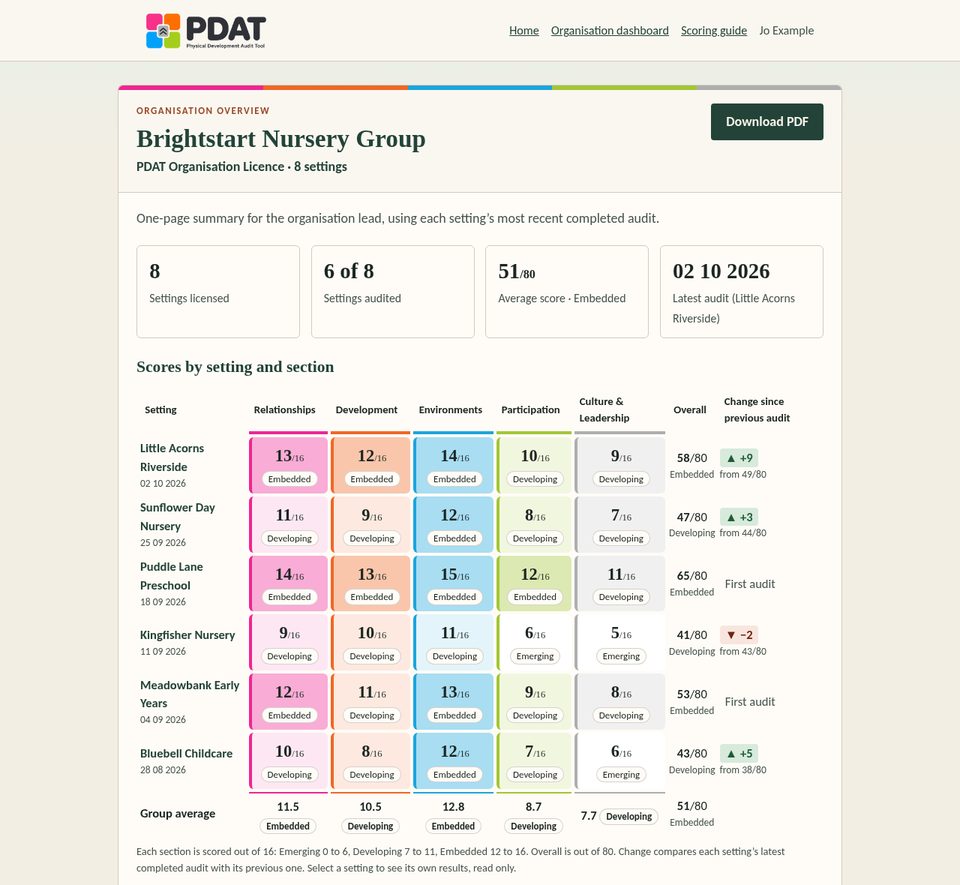
With an Organisation licence, the organisation lead gets one page that brings together the PDAT results from every setting in the group.
For Stronger Practice Hubs, family hubs, local authorities, academy trusts, school groups, Active Partnerships and other early years organisations.
- Every setting’s scores side by side, across all five sections
- Group strengths and areas for support
- The top shared priorities, each with a quick win
- Which settings have completed their audit, and which have not yet
- A one-page PDF to share with managers, trustees or colleagues
- Add settings and invite their staff from one place
Or email pdat@inspectorplay.com
The framework behind PDAT
Built on Building Blocks for an Active Start
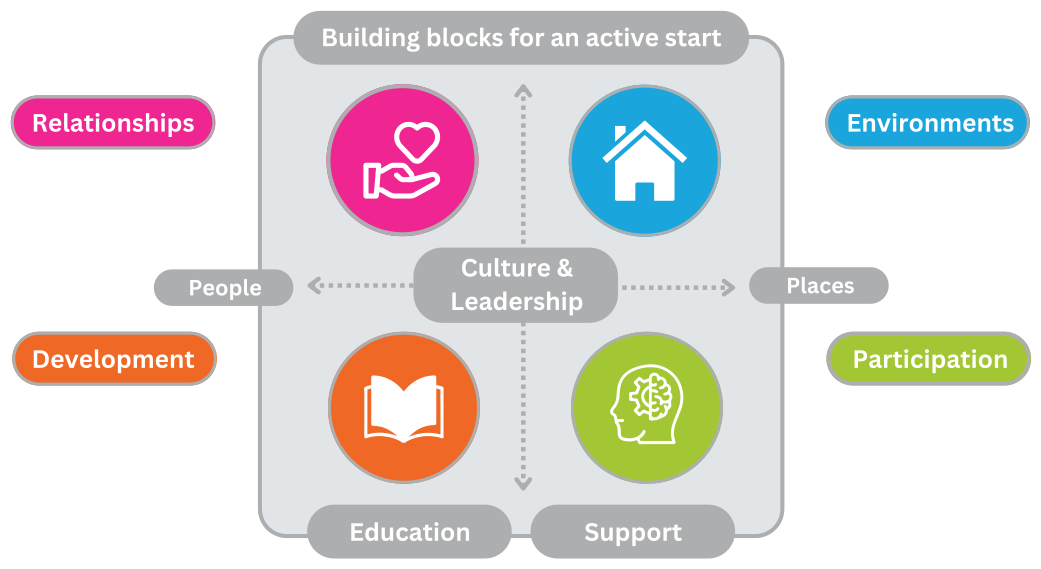
Building Blocks for an Active Start sets out key principles for supporting movement and physical development in early childhood. Each is connected to the Physical, Social, Cognitive and Affective domains of physical literacy, from birth to school age.
Every PDAT statement links to a Building Blocks principle or foundation, and the recommendations bring them to life with practical examples for infants (0–1), toddlers (1–3) and pre-schoolers (3–5).
The framework was first developed through work Natalie and Helen carried out in 2025 with HENRY (Health, Exercise and Nutrition for the Really Young), a national early years organisation, which now uses it in its training materials. The work is aligned to Sport England’s definition of physical literacy.
Building Blocks for an Active Start complements the EYFS, Birth to 5 Matters and Development Matters, and supports the physical development guidance settings already use.
Download the Building Blocks framework
PDAT and the Building Blocks framework © Weir & Battelley.
Additional services
Consultancy and training
Alongside PDAT, Dr Natalie Weir and Helen Battelley MA each offer consultancy, staff training, conference keynotes and workshops, and research and policy support on physical development and physical activity in early childhood.
They also often work together on projects, such as their 2025 work with HENRY (Health, Exercise and Nutrition for the Really Young), a national early years organisation.